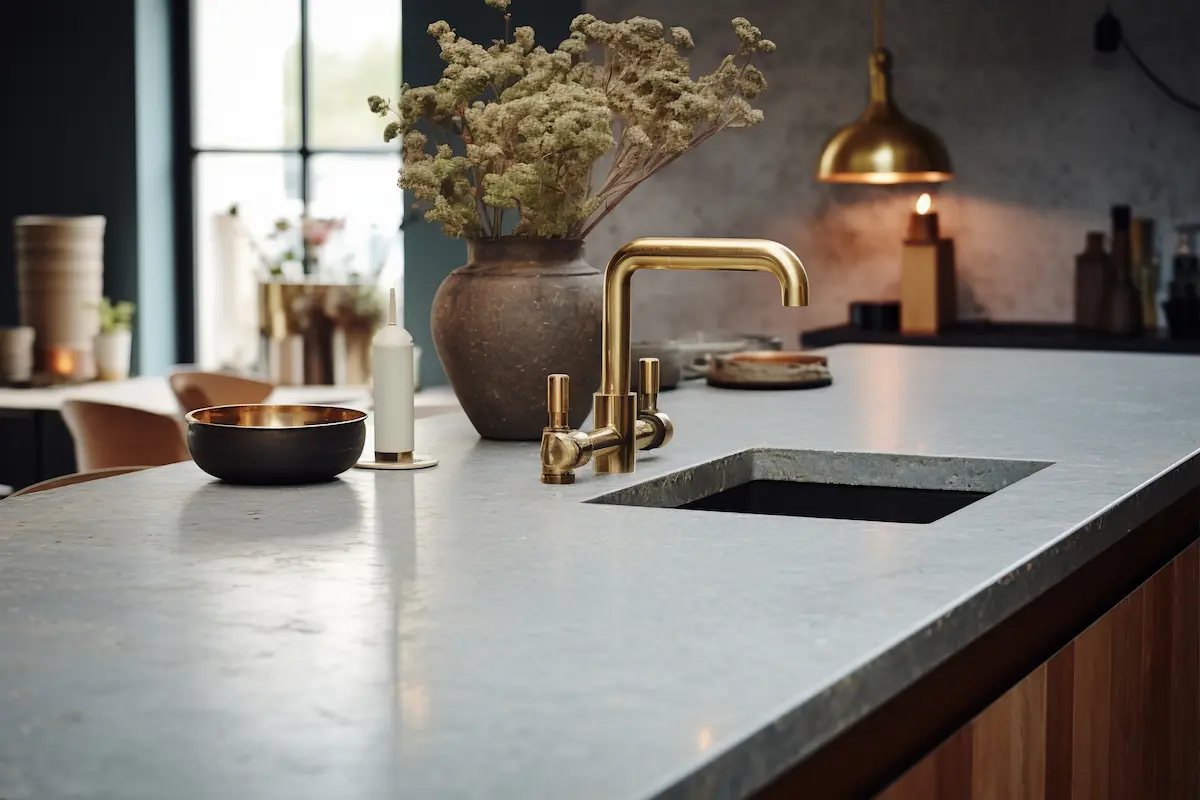
Choosing the right kitchen countertop is one of the most important decisions in any home remodeling project. With countertop trends 2026 shifting toward warm tones, natural materials, and low-maintenance surfaces, homeowners are asking: What is the best countertop material for a kitchen? Is quartz better than marble? Which countertop is more durable? This comprehensive guide answers all your questions by comparing the three most popular materials—quartz, quartzite, and marble—covering everything from durability and maintenance to cost and design aesthetics.
According to the National Kitchen & Bath Association (NKBA), quartz remains the top choice for countertops in 2026, favored by 78% of industry professionals. However, quartzite—particularly warm-toned varieties like Taj Mahal quartzite—is rapidly gaining popularity for those seeking natural stone beauty with enhanced durability. Meanwhile, marble countertops continue to offer unmatched elegance for homeowners willing to invest in maintenance.
Key Takeaways
- Quartz countertops offer the best combination of durability, low maintenance, and design variety—ideal for busy families
- Quartzite delivers natural stone beauty with superior heat resistance, making it the rising star of 2026
- Marble remains the gold standard for luxury but requires regular sealing and careful maintenance
- 2026 trends favor honed/matte finishes over high-gloss, and warm earth tones over stark whites
- Cost ranges from $50-$200 per square foot installed, depending on material and quality grade
- Visit a showroom to see samples in person—photos don’t capture the true character of natural stone
Table of Contents
- Understanding the Three Materials: Quartz, Quartzite & Marble
- Countertop Trends 2026: What’s In and What’s Out
- Complete Comparison: Durability, Maintenance & Heat Resistance
- Cost Breakdown: Price Per Square Foot Compared
- Best Countertop for Your Lifestyle
- Popular Countertop Colors and Finishes for 2026
- Edge Profiles: From Waterfall to Bullnose
- Frequently Asked Questions
1. Understanding the Three Materials: Quartz, Quartzite & Marble
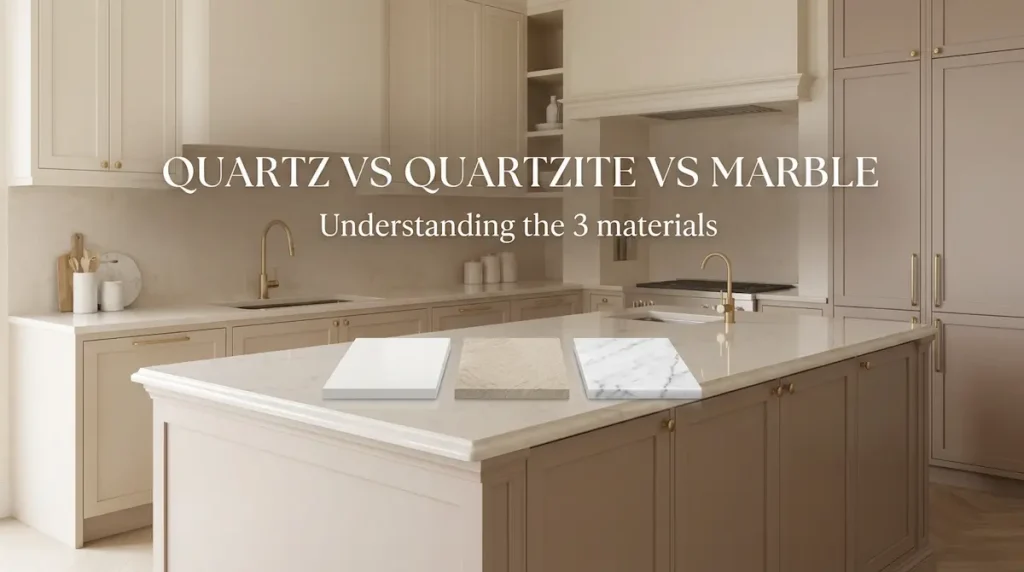
Before diving into comparisons, it’s essential to understand what each material actually is. Many homeowners confuse quartz and quartzite—despite similar names, they’re completely different materials with distinct properties.
What is Quartz? (Engineered Stone)
Quartz countertops are engineered surfaces made from approximately 90-95% ground natural quartz crystals combined with polymer resins, pigments, and other minerals. Leading brands like Caesarstone, Silestone, Cambria, and MSI Surfaces manufacture these slabs under controlled conditions, offering consistent patterns and an extensive range of colors—including designs that mimic Calacatta marble or Carrara marble at a lower price point.
Because quartz is non-porous, it doesn’t require sealing and resists stains, bacteria, and moisture—making it a top choice for low maintenance countertops. Popular options include Calacatta Nuvo by Caesarstone and HanStone Quartz collections that deliver marble aesthetics without the maintenance concerns.
What is Quartzite? (Natural Stone)
Quartzite is a 100% natural metamorphic rock formed when sandstone is subjected to extreme heat and pressure deep within the Earth. This process transforms the original quartz grains into an interlocking crystalline structure that’s incredibly hard—ranking 7 on the Mohs Hardness Scale (compared to marble’s 3). The result is a durable kitchen countertop that combines the beauty of natural stone with exceptional performance.
The star of 2026 is undoubtedly Taj Mahal quartzite—a warm, creamy stone with subtle gold and gray veining that delivers marble-like elegance with far greater durability. Other popular varieties include Fantasy Macaubas quartzite with its dramatic green-gray veining, perfect for those seeking a statement piece in their kitchen renovation.
What is Marble? (Natural Stone)
Marble is a metamorphic rock that forms when limestone undergoes intense heat and pressure. The calcite in limestone recrystallizes to create the distinctive veining patterns that have made marble a symbol of luxury for centuries—from ancient Roman architecture to modern interior design trends. Each slab is truly unique, offering one-of-a-kind character that no engineered material can replicate.
While Carrara marble remains a classic choice with its soft gray veining on white background, Calacatta marble commands premium prices for its bolder, more dramatic veining. However, marble is porous and softer than both quartz and quartzite, requiring regular sealing and maintenance to prevent staining and etching from acidic substances.
Quick Reference: Material Composition
| Property | Quartz | Quartzite | Marble |
| Type | Engineered Stone | Natural Stone | Natural Stone |
| Composition | 90-95% quartz + resin | Metamorphic sandstone | Metamorphic limestone |
| Mohs Hardness | 7 | 7 | 3 |
| Porosity | Non-porous | Slightly porous | Porous |
| Pattern Consistency | Uniform/Predictable | Each slab unique | Each slab unique |
2. Countertop Trends 2026: What’s In and What’s Out
The best kitchen countertops 2026 reflect broader shifts in interior design—away from stark, sterile aesthetics toward warmer, more organic spaces. According to Houzz design trend reports and industry experts, here’s what’s shaping countertop selections this year.
What’s IN for 2026
- Honed and matte finishes: High-gloss surfaces are giving way to softer, more tactile honed vs polished countertops that hide fingerprints and scratches while feeling more organic
- Warm earth tones: Creamy whites, soft beiges, warm taupes, and subtle gold veining are replacing cool grays
- Natural stone with character: Homeowners want unique veining and organic variation—not factory-perfect uniformity
- Quartzite’s rise: The “Taj Mahal effect” continues as designers recommend quartzite for marble-lovers who want durability
- Leathered finishes: A textured, slightly matte surface that adds depth and hides imperfections beautifully
- Full-height backsplashes: Extending the same countertop material up the wall for a seamless, luxurious look
What’s OUT for 2026
- Waterfall edges: According to 36% of designers surveyed, the cascading countertop trend is feeling dated and overly ubiquitous
- High-contrast veining: Dramatic dark veins on stark white backgrounds are being replaced by softer, more subtle patterns
- Speckled granite: The “TV static” look of early 2000s granite is firmly dated—12% of designers explicitly advise against it
- Pixelated quartz: Engineered patterns that look obviously artificial are losing favor to natural stone aesthetics
- Brown granite: Once ubiquitous, brown tones from the mid-2000s are now considered dated
| ✓ Trending IN 2026 | ✗ Trending OUT 2026 |
| Taj Mahal quartzite, warm quartz tones | Stark white with dark veining |
| Honed & leathered finishes | High-gloss polished surfaces |
| Subtle, organic veining | Dramatic, high-contrast patterns |
| Bullnose & eased edges | Waterfall edge profiles |
| Earthy greens, warm taupes | Cool gray tones |
3. Complete Comparison: Durability, Maintenance & Heat Resistance
When evaluating kitchen countertop materials comparison, the most critical factors are durability, maintenance requirements, and heat resistance. Here’s how our three contenders stack up in real-world kitchen conditions.
Durability: Which Countertop Lasts Longest?
For durable kitchen countertops, the ranking based on the Mohs Hardness Scale is: quartzite (7), quartz (7), followed by marble (3). However, hardness isn’t everything—you must also consider chip resistance, crack susceptibility, and everyday wear patterns.
Quartz wins for scratch and stain resistance in daily use because its engineered composition includes binding resins that create a non-porous surface. It handles heavy kitchen traffic exceptionally well, making it ideal for best countertops for busy kitchens with kids.
Quartzite offers natural stone durability that can withstand decades of use when properly sealed. It’s harder than granite and significantly more durable than marble, aging gracefully with a beautiful patina over time.
Marble is the softest of the three and most susceptible to scratching, chipping, and etching. However, many homeowners embrace the “lived-in” character that develops over time—designer Leanne Ford notes, “I love when a countertop shows its life: the etching, the scratches, the memories.”
Maintenance: Sealing, Cleaning & Daily Care
For homeowners seeking low maintenance countertops, quartz is the clear winner:
- Quartz: Zero sealing required. Clean with mild soap and water. Non-porous surface resists bacteria and staining.
- Quartzite: Requires sealing every 1-3 years depending on porosity. Acidic substances should be wiped quickly.
- Marble: Needs sealing every 6-12 months. Highly susceptible to etching from wine, citrus, vinegar, and tomatoes. Requires immediate cleanup of spills.
Heat Resistance: Can You Put Hot Pans on Countertops?
This is where natural stone countertops have a distinct advantage over engineered options:
Quartzite and marble are both heat resistant countertops that can handle hot pots and pans directly without damage—they formed under extreme geological heat, after all.
Quartz, despite its durability, is NOT heat-proof. The resin binders can discolor or even melt under extreme heat (typically above 300°F). Always use trivets or hot pads with quartz countertops.
Complete Property Comparison Chart
| Property | Quartz | Quartzite | Marble |
| Scratch Resistance | ★★★★★ Excellent | ★★★★★ Excellent | ★★☆☆☆ Fair |
| Stain Resistance | ★★★★★ Excellent | ★★★★☆ Very Good | ★★☆☆☆ Fair |
| Heat Resistance | ★★★☆☆ Moderate | ★★★★★ Excellent | ★★★★★ Excellent |
| Maintenance | ★★★★★ Minimal | ★★★☆☆ Moderate | ★★☆☆☆ High |
| Sealing Required | Never | Every 1-3 years | Every 6-12 months |
| Uniqueness | Uniform patterns | Each slab unique | Each slab unique |
| Lifespan | 10-15+ years | 20-50+ years | 20-50+ years* |
| Best For | Busy families | Luxury with durability | Light use, elegance |
*With proper maintenance and care
4. Cost Breakdown: Price Per Square Foot Compared
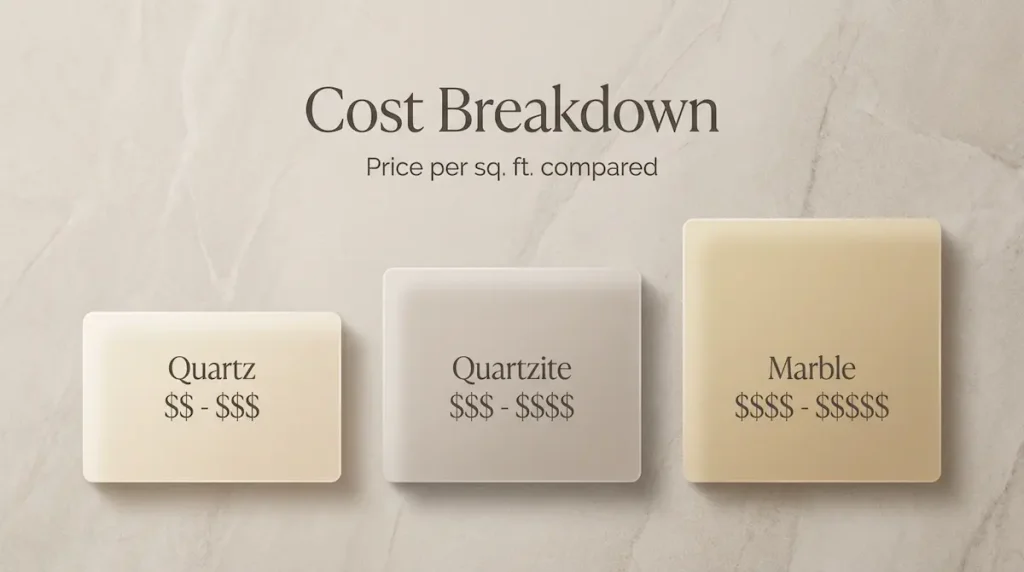
Understanding countertop cost per square foot helps you budget effectively for your kitchen remodeling project. Prices vary based on material grade, brand, slab thickness, edge profile, and countertop installation cost in your region.
| Material | Budget Range | Mid-Range | Premium |
| Quartz | $50-$70/sq ft | $70-$100/sq ft | $100-$150/sq ft |
| Quartzite | $70-$100/sq ft | $100-$150/sq ft | $150-$200+/sq ft |
| Marble | $40-$75/sq ft | $75-$125/sq ft | $150-$250+/sq ft |
Note: Prices include fabrication and installation. Additional costs may apply for edge profiles, cutouts for sinks, and removal of existing countertops. For accurate pricing in your area, we recommend visiting a local showroom where you can see actual slabs and discuss your specific project requirements.
Factors That Affect Countertop Pricing
- Slab thickness: 3cm (1.25″) is premium and more durable; 2cm is budget-friendly and suitable for bathrooms
- Edge profiles: Simple eased edges cost less; ornate ogee or dupont edges add $10-$30 per linear foot
- Cutouts and notches: Each sink cutout, cooktop opening, or notch adds $100-$300
- Slab rarity: Exotic quartzite and premium Calacatta marble can exceed $300/sq ft
- Geographic location: Installation costs vary significantly by region—metropolitan areas typically cost 15-25% more
5. Best Countertop for Your Lifestyle
The best countertop material ultimately depends on how you use your kitchen, your maintenance tolerance, and your aesthetic preferences. Here’s a guide to help you decide:
Choose Quartz If…
- You have a busy household with kids who spill frequently
- Low maintenance is a top priority—you don’t want to worry about sealing
- You want consistency—the sample you see is exactly what you’ll get
- Budget is a consideration but you still want a premium look
- You’re comfortable always using trivets for hot cookware
Choose Quartzite If…
- You love natural stone but need more durability than marble offers
- Heat resistance is important—you cook frequently with hot pans
- You appreciate unique, one-of-a-kind veining patterns
- You’re willing to commit to periodic sealing (every 1-3 years)
- You want a long-term investment that ages gracefully
Choose Marble If…
- Luxury and timeless elegance are your top priorities
- You’re a dedicated baker—marble stays naturally cool for pastry work
- You embrace patina and don’t mind “loved” surfaces over time
- Your kitchen is light-use or you’re installing in a secondary area
- You commit to regular sealing and careful maintenance
| Your Lifestyle | Best Choice | Good Alternative | Avoid |
| Busy family with young kids | Quartz | Quartzite | Marble |
| Avid home cook/entertainer | Quartzite | Granite | — |
| Serious baker | Marble | Quartzite | — |
| Design-focused, light use | Marble | Quartzite | — |
| Investment property/resale | Quartz | Granite | Marble |
6. Popular Countertop Colors and Finishes for 2026
The color and finish you select dramatically impacts your kitchen’s overall aesthetic. Countertop finishes matte honed polished options each create different moods—from contemporary to classic. Here are the trending choices for 2026:
Trending Countertop Colors 2026
- Warm whites and creams: Moving away from stark bright white toward softer, creamier tones
- Earthy taupes and beiges: Grounding tones that complement natural wood cabinetry
- Soft greens (sage, olive): Biophilic design influence bringing nature indoors
- Deep moody tones: Charcoal, navy, and forest green for dramatic statements
- Gold and bronze veining: Warm metallic tones replacing cool gray veining
Understanding Finish Options
| Finish Type | Characteristics | Best For |
| Polished | High-gloss, reflective surface; shows scratches and fingerprints more easily | Formal spaces, light-colored stones where you want maximum brightness |
| Honed | Matte, velvety smooth; reduces shine while maintaining sleek look | Contemporary kitchens, high-traffic areas, darker stones |
| Leathered | Textured, slightly matte with tactile surface; hides imperfections | Rustic or transitional styles, busy households, hiding fingerprints |
| Brushed | Subtle linear texture; softer than leathered but more character than honed | Farmhouse and transitional kitchens, natural stone applications |
7. Edge Profiles: From Waterfall to Bullnose
The countertop edge profiles you choose adds another design dimension to your kitchen island countertop ideas. While waterfall countertop edge designs (where the stone cascades to the floor) dominated recent years, 2026 trends favor softer, more approachable profiles.
| Edge Profile | Description | 2026 Trend Status |
| Eased/Straight | Slightly rounded top edge with squared sides; clean and modern | ★★★★★ Popular |
| Bullnose | Fully rounded edge; soft, family-friendly, timeless | ★★★★☆ Classic |
| Beveled | Angled cut along top edge; adds dimension | ★★★☆☆ Steady |
| Ogee | S-shaped curve; traditional, elegant | ★★★☆☆ Traditional |
| Dupont | Curved top with straight drop; sophisticated | ★★★★☆ Rising |
| Waterfall | Countertop extends down island sides to floor | ★★☆☆☆ Declining |
| Mitered | Thick appearance created by joining pieces at 45° | ★★★★☆ Rising |
8. Frequently Asked Questions
Q1: What is the best countertop material for a kitchen in 2026?
For most homeowners, quartz offers the best combination of durability, low maintenance, and design versatility. It’s non-porous, never needs sealing, and comes in hundreds of colors and patterns. However, if you prioritize natural stone beauty and heat resistance, quartzite (especially Taj Mahal) is the rising star of 2026. For luxury aesthetics and you’re willing to maintain it, marble remains unmatched.
Q2: Is quartz cheaper than marble?
Not necessarily. Entry-level marble (like Carrara) can cost $40-$75/sq ft, while premium quartz brands can reach $150/sq ft. The real difference is in maintenance costs over time—marble requires regular sealing and may need professional restoration, while quartz is virtually maintenance-free.
Q3: Can you put hot pans on quartz countertops?
No—always use trivets or hot pads with quartz. The resin binders in quartz can discolor or crack under extreme heat (typically above 300°F). Quartzite and marble, being natural stones, handle heat much better and can tolerate hot pans directly, though trivets are still recommended as best practice.
Q4: What is the difference between quartz and quartzite?
Despite similar names, they’re completely different. Quartz is an engineered stone (90% ground quartz + resin) manufactured for consistency. Quartzite is 100% natural metamorphic rock mined from the earth, with unique veining in each slab. Quartzite requires sealing; quartz does not. Quartz offers more color variety; quartzite offers natural uniqueness.
Q5: Does quartz countertop need to be sealed?
No, quartz countertops never need sealing. Because they’re engineered with non-porous resin binders, they naturally resist stains, bacteria, and moisture. This is one of the biggest advantages over natural stones like marble (seal every 6-12 months) and quartzite (seal every 1-3 years).
Q6: Are waterfall countertops still in style for 2026?
Waterfall edges are declining in popularity. According to design surveys, 36% of interior designers consider them dated and overly ubiquitous. While they can still work in specific contemporary designs, 2026 trends favor softer edge profiles like bullnose, dupont, and mitered edges that feel warmer and more residential.
Q7: What countertop adds the most value to a home?
Quartz currently offers the best ROI for resale because buyers recognize it as a premium, low-maintenance material. Well-maintained granite also performs well. Marble can add significant value in luxury markets but may concern some buyers due to maintenance requirements. The key is quality installation and choosing timeless colors over trendy ones.
Q8: How do I choose between so many countertop options?
Start by honestly assessing your lifestyle: How much cooking do you do? Do you have kids? What’s your maintenance tolerance? Then visit a showroom to see actual slabs—photos don’t capture the true depth and character of natural stone. Bring cabinet samples, paint chips, and flooring samples to see how materials work together. A good showroom consultant can guide you through the selection process and help you find the perfect match.
Find Your Perfect Countertop at Vega Kitchen & Bath
Choosing the right countertop is a significant investment that impacts both the beauty and functionality of your kitchen for decades. At Vega Kitchen & Bath in White Plains, New York, we offer over 200 samples of high-quality quartz and natural stone countertops for every budget and style preference.
Our experienced design team provides complimentary 3D renderings so you can visualize exactly how different countertop materials will look in your space. Visit our 5,500 square foot showroom to see full slabs of Taj Mahal quartzite, Calacatta marble, premium quartz from top brands, and much more—all in one convenient location serving Westchester County and the greater New York area.
Ready to start your kitchen transformation? Schedule a consultation with our countertop specialists today and discover why families throughout Westchester trust Vega Kitchen & Bath for their home remodeling projects.
Related Resources:
- Kitchen Cabinet Color Trends 2026 – Pair your new countertops with trending cabinet colors
- Bathroom Tile Trends 2026 – Coordinate your kitchen and bathroom materials
- Statement Backsplashes Guide – Complete your kitchen design
- Timeless Kitchen Design – Create a kitchen that endures
- Our Tiles & Mosaics Collection – Explore our tile selection
- Bathroom Vanities – Browse vanity options for your bathroom
Industry data referenced from the National Kitchen & Bath Association (NKBA) 2026 Design Trends Report and Houzz Kitchen Trends Study.